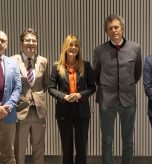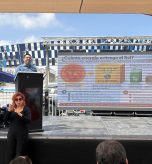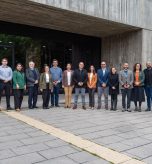


The CHILECON 2013 Engineering Congress was held with a large attendance. Among the invited guests were prominent national and international researchers, who presented various topics related to solar energy and smart grids.
Last Monday, September 9, and Tuesday, September 10, the CHILECON 2013 Engineering Congress took place, an event organized by the IEEE Chile Section, in conjunction with Universidad Adolfo Ibáñez, SERC Chile, the Energy Center, and the Faculty of Physical and Mathematical Sciences of the University of Chile. On this occasion, the theme of the meeting centered on the development of Solar Energy and Smart Grids, two areas that represent significant energy opportunities for Chile and where the discussion on technological development aims to realistically supply current systems. Professor Hugh Rudnick, from Universidad Católica, was in charge of opening the ceremony and emphasized the importance of reactivating engineering congresses in Chile with this event. “In Chile, there was a loss of prominence in Electrical Engineering congresses due to researchers' preference for publishing in national journals. The great value of reactivating them is to provide forums and ensure people's participation to succeed in turning them into a real space for research and development exchange in the country,” he explained. For his part, Professor Rodrigo Palma, Director of SERC Chile, commented that the congress seeks to become a meeting point for young innovators, motivating them to think about these topics. “IEEE Chile Section wanted to revitalize national activities and organize CHILECON 2013 this year, which we hope will be the first in a series of events that allows presenting academic topics to students, to generate an appropriate bridge between the real world and the energy world,” he said. The first day of CHILECON focused on the State of Smart Grids in Chile and began with a Panel Session led by Professor Luis Vargas, from the University of Chile; with the participation of Alex Alegría, from Transelec, and Rodrigo Palma, from the University of Chile. The second session of the day was chaired by Héctor Galleguillos, Principal Investigator of Line 4, Solar Energy Storage; along with Professor Gustavo Cáceres, from Universidad Adolfo Ibáñez; Carlos Suazo, from the Energy Center of the University of Chile; and Jaime Aleé, from the Lithium Innovation Center of the University of Chile. The first day concluded with the session on Economic Models for Solar Energy Integration, led by Professor Carlos Silva, from Universidad Adolfo Ibáñez; and presentations by Professor Rodrigo Moreno, from the University of Chile; and Professor Gerardo Blanco, from the National University of Asunción, Paraguay. The second day of CHILECON began with a presentation by Professor Claudio Cañizares, from the University of Waterloo, Canada, and focused on the discussion of Smart Grids and Communication Systems; followed by a panel session headed by Professor Rodrigo Palma of the University of Chile; with the participation of Professor Massoud Amin, from the University of Minnesota; and Professor Claudio Estévez, from the University of Chile. During the same morning, the Microgrid Panel Session was held, led by Guillermo Jiménez, from the University of Chile; it featured presentations by Rosa María Argomedo, from the Ministry of Energy; Professor Reza Iravani, from the University of Toronto, Canada; Professor Nikos Hatziargyriou, from the National Technical University of Athens, Greece; and Professor Ryochi Hara, from Hokkaido University, Japan. Finally, CHILECON concluded with the Panel Session Challenges for Smart Grids and Solar Energy, chaired by Professor Samir Kouro, Principal Investigator of SERC Chile's Line 1, Solar Energy in Industry/Mining. The speakers on this occasion were Cleiton Silva, from ABB; Professor Claudia Rahmann, from the University of Chile; and Professor Patricio Mendoza, from the University of Wisconsin–Madison and the University of Chile. The objective of the congress was to emphasize the development of smart grids and solar energy as an opportunity for our country, creating an instance to present these relevant topics as new technologies; as well as to encourage the integration of multi-university and multidisciplinary groups that will enable the great leap toward renewable energies.