

The four-wheeled solar vehicle -created by students- demonstrated that it is capable of running alongside a sophisticated Tesla Model S, the only one of its kind in South America.
The EOLIAN project was born in 2007 as a student project, guided by the Departments of Mechanical and Electrical Engineering at the University of Chile—an initiative supported by the Institute for Complex Engineering Systems—to serve as a cradle for innovators. The history that began approximately seven years ago with the construction of EOLIAN 1 will reach a milestone this coming November when EOLIAN 4, the first two-seater off-road solar car in Latin America and the Caribbean, participates in the Atacama Solar Challenge 2014.
By then, the investment will have reached the significant sum of nearly 100 million pesos. This is an amount well worth it for a vehicle designed as an alternative to combustion-engine cars, capable of traveling long distances, as it will demonstrate in the first race of its kind in the north, covering approximately 1,200 kilometers.
“This is not a tricycle, but a four-wheeled car. It does not need to be towed when there are problems on the track. The aim is to move closer and closer to an everyday vehicle. We believe it has the potential to become a commercial car,” says Rodrigo Palma, Director of the Energy Center and researcher at the Institute for Complex Engineering Systems.
Features of the EOLIAN 4
How does the EOLIAN 4 work? It utilizes photovoltaic cells that convert solar radiation into electrical energy, with a total power output of 900 W in full sun. It uses lithium-ion batteries and two motors with a maximum power of 7 KW (9.3 hp), 55 Nm of torque, an autonomy of 400 kilometers, and reaches speeds of up to 100 kilometers per hour. Since it does not consume fossil fuels, it does not emit CO2, resulting in a very low carbon footprint.
Now that the solar panels, steering suspension, and basic fairing have just been tested, the EOLIAN 4 is nearly ready, not only for the most important solar race in Latin America but also to travel across Chile from Arica to Santiago, visiting various schools to demonstrate the advantages of using solar energy.
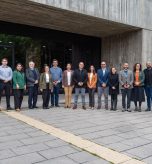
The project team, coordinated by researcher Rodrigo Palma along with a professional team from the Energy Center and the DIE (José Antonio Marín, Mónica Zamora, Vladimir Ovalle, Bernardo Severino), is composed of students, staff, and academics from Electrical, Mechanical, Industrial, and Business Engineering, as well as Industrial and Graphic Design. Its development was made possible by the support of research centers and companies that recognize the potential of new technologies and their positive impact on the country.