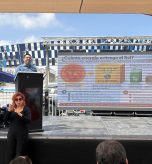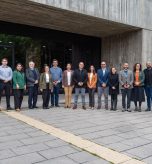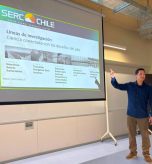


The first Workshop for Research Strategies for Solar Energy and Basic Sciences is an international event organized by SERC Chile and CMM (Center for Mathematical Modeling) (through the REDERG008 project by CONICYT-DRI), where the future of basic sciences related to solar energy and research strategies will be discussed.
Different national and international presenters will analyze the physical foundations of solar energy during the meeting, as well as the main opportunities for technological development and advances in the field of basic sciences.
The workshop will encourage discussion among key decision-makers regarding national strategies for solar energy research.
It is aimed at:
Academics and researchers in the fields of physics and solar energy.
Technological developers interested in solar energy applications.
Postgraduate students interested in solar energy research.
The workshop will be held on January 23, 24, 27, and 28 in the Presidential Hall of the National Congress Building in Santiago (441 Morandé Street).
In addition, on January 27, a mini-symposium will be held: Integration of solar energy and energy management in urban transport systems; where applications of solar energy in urban transport systems will be discussed and analyzed, alongside efficiency measures to reduce energy consumption in the transportation sector.
This meeting will focus on an open discussion to explore future alternatives for cooperation between urban planning, transportation, and solar energy.
As a complementary activity, on January 21 and 22, an Introduction to Solar Energy course will be held, taught by Roberto Román. This is an open introductory course covering various solar energy conversion methods and basic software use, among other subjects.
For more information and details on these events, please send an email to Mariel Lizana at mariel.lizana@wordpress-1152908-4037284.cloudwaysapps.com and follow these links:
1st Workshop on Research Strategies in Solar Energy and Basic Sciences
Mini-Symposium: Integration of solar energy and energy management in urban transport systems
Introduction to Solar Energy in Chile
| Thursday, January 23th: Module I: PV Module for the Atacama Desert | |
| 09:00 | Reception |
| 09:30 – 10:00 | Opening Session.
Rodrigo Palma, SERC Chile. |
| 10:00 – 10:45 | Radovan Kopecek, ISC Konstanz. “Need for development of a bifacial glass-glass module for Atacama Desert: high power AtaMo with Chile’s local content” |
| 10:45 – 11:15 | Open discussion and reflections |
| 11:15 – 11:45 | Coffee break. |
| 11:45 – 12:30 | Enrique Cabrera, ISC Konstanz. “Metallization technology for contacting emitters in crystalline silicon (Si) solar cells” |
| 12:30 – 13:00 | Open discussion and reflections |
| 13:00 – 14:30 | Lunch |
| 14:30 – 15:15 | Axel Metz; H.A.L.M. Electronik Gmbh “Advanced characterization of solar cells and PV modules” |
| 15:15 – 15:45 | Open discussion and reflections |
| 15:45 – 16:00 | Coffee break |
| 16:00 – 18:00 | Working groups (Three tables) |
| Friday, January 24th: Module I (Final): PV Module for the Atacama Desert | |
| 09:00 | Reception |
| 09:30-11:00 | Main conclusions of working groups. |
| 11:00-11:30 | Coffee break. |
| 11:30-13:00 | Discussion Panel and Conclusions Module I: “Strategies for solar cell development in northern Chile” Chair: Rodrigo Palma |
| 13:00-14:30 | Lunch |
| Friday, January 24th: Module II: | |
| 14:30 – 14:45 | Introduction: Marcelo Matus, SERC Chile. |
| 14:45 – 15:15 | Eduardo Soto, Fundación Chile.“Importance of reducing uncertainty in radiation measurement for the design and operation of solar power plants” |
| 15:15 – 16:45 | Francisco Mardones, Nimbic. “Doing basic sciences and high-technology software from Chile: Nimbic experience” |
| 16:45 – 17:00 | Coffee break. |
| 17:00 – 17:30 | Ernest Michael, Radio Astronomical Instrumentation Group, Universidad de Chile (Pending confirmation) |
| 17:30 – 18:00 | Final Discussion and Conclusions Module II.
Chair: Marcelo Matus |
| Monday, January 27th: Module III: | |
| 09:00 | Reception. |
| 09:30 – 09:45 | Introduction: Marcelo Matus, SERC Chile. |
| 09:45 – 10:30 | Jaime Llanos, Universidad Católica del Norte. “Down-Conversion and Up-Conversion Luminescent Materials for Application in Solar Cells”. |
| 11:00 – 11:30 | Coffee break. |
| 11:30 – 13:00 | Conference: Laborelec (Pending confirmation). |
| 13:00 – 15:00 | Lunch. |
| 15:00 – 18:00 | Mini-Symposium: “Integration of solar energy and energy management in urban transport systems”.
Chair: Jorge Amaya (see info) |
| Tuesday, January 28th: Module IV: Solar Energy Research Strategies | |
| 09:00 | Reception. |
| 09:30- 11:00 | Conference: Stephan Koch, Philipps-Universität Marburg, Germany. |
| 11:00-11:30 | Coffee break. |
| 11:30- 13:00 | Conference: Wolfgang Stolz, Philipps-Universität Marburg, Germany. |
| 13:00- 15:00 | Lunch. |
| 15:00- 17:00 | Panel Discussion: “Opportunities and challenges for a solar energy research strategy”.
Chair: Marcelo Matus |
| 17:00-18:00 | Closing cocktail. |
Speakers:
Enrique Cabrera
Dr. Enrique Cabrera received his Dipl.-Ing. degree (honors) in electrical engineering and electrical power systems from the Universidad de Santiago de Chile (USACH) in 2008. As a part of his studies, he spent two semesters at the Rheinisch-Westfälische Technische Hochschule (RWTH) Aachen in Germany as a DAAD scholarship holder. During this time, he attended numerous lectures, seminars and field trips dealing with renewable energy. In 2013, he received his PhD degree in physics in the field of metallisation of silicon solar cells at the International Solar Energy Research Center (ISC) Konstanz in cooperation with the University of Konstanz. He is currently working on the EU Project Hercules and supporting research and development cooperation projects in Chile and South America.
Abstract:
“Metallization technology for contacting emitters in crystalline silicon (Si) solar cells”.
Screen printing is predicted to remain the most widely spread metallization technology for contacting emitters in crystalline silicon (Si) solar cells until 2016 and we believe that this dominance will last at least 15 more years. Its successful development has been possible due to its high degree of industrialization and due to the lack of market ready, cost-effective alternatives. The current most important limitation is that the silver (Ag) used in the front contact screen printed paste is the second most important material cost factor in the current solar cell fabrication process. 14% of the world Ag supply is estimated to be consumed by the photovoltaic industry in 2015 and the Ag price is expected to continue to increase. This drastic growth in demand raises the need for alternatives. An interesting substitute of Ag is provided by Copper (Cu) due to its high conductive and low cost. However, the major drawback of Cu is its high diffusion coefficient in Si even at room temperature paired with its detrimental influence on the Si properties. In this presentation, we summarize the properties and potential of existing Ag-technology. In the second part we will analyse the promising approach by Cu as contacting material and economical alternative, which could provide an opportunity for the growth in the Chilean Cu production.
Radovan Kopecek
Dr. Radovan Kopecek, born in Brno (former Czechoslovakia), obtained his Diploma in Physics at the University of Stuttgart in 1998, researching superconductive fullerides. In addition, he studied at Portland State University (Oregon, USA) for one year, where he obtained a Master of Science in 1995. Towards the end of his studies in Stuttgart, he worked at the Max-Planck-Institut (MPI) and afterwards at the Institute of Physical Electronics (IPE) as a research assistant in the field of crystalline Si for PV applications. He joined Professor Ernst Bucher’s Konstanz-based group in 1998 in order to write his PhD dissertation on the topic of thin film silicon solar cells, which he completed in November 2002. Until the end of 2006, he headed several national and international projects at the University of Konstanz as a group leader. These projects focused on silicon feedstock and the development of crystalline Si thin film n-type solar cells. One of the founders of ISC Konstanz, Dr. Kopecek has been working at the institute as a full time manager and researcher since January 2007, and is currently the leader of the Advanced Solar Cells department. He is responsible for several European and national research projects that revolve around silicon feedstock and around the development of solar cells, with a focus on n-type devices. Further, Dr. Kopecek has been teaching the basics and applications of PV at the DHBW in Friedrichshafen since 2012.
Abstract:
“Need for development of a bifacial glass-glass module for Atacama Desert: high power AtaMo with Chile´s local content”.
According to the ITRPV (International Roadmap for PV), a large fraction of future solar cells will be n-type solar cells with the highest efficiencies and fabricated using low-cost processes. As the standard p-type silicon solar cell in mass production is completely optimized and has therefore reached its cost limit, it is currently very difficult for new solar cell concepts to be cost effective from the outset when introduced into production. Consequently, in the current market situation, the introduction of new solar cell concepts to the market is not straightforward. The only way to achieve this is to use the fully adapted standard processes employed in today’s manufacturing lines and only upgrade them with a few industrially approved process steps – such as laser ablation and boron diffusion – in order to implement low-cost device structures with stable efficiencies well above 20%.
Such n-type solar cells are in 80% of the cases bifacial and show a very good response from the rear as well. Many module companies are switching their production to glass-glass modules, as on one hand glass is becoming cheaper than the back sheet and on the other such modules are more stable in time. This opens new paths for bifaciality as bifacial systems can have a gain in energy yield of up to 30% and therefore make the total invest into the such system extremely interesting. For desert conditions such modules have to be adapted, which will be the focus of this talk. The author will describe how desert modules have to behave and how AtaMo (Atacama Module) can also include Chile´s local content such as Cu-Metallization. This will be described in more detail by Dr. Enrique Cabrera who made his PhD on screen printed metallization for PV mass production.
This talk will give as well an overview of n-type and bifacial cell concepts already present on the market and of promising technologies ready for pilot production; the latter were summarized and discussed at the 3rd nPV workshop in April 2013 in Chambéry, France and will be shown in progress again at the 4th nPV workshop in March 2014 in Herstogensbosch, Netherlands. In order to introduce bifaciality faster into the PV market, ISC Konstanz and INES organize the second bifacial workshop on 26th/27th May 2014 in Chambery, France. The consequences for module manufacturing, as well as for measurement techniques and for requirements in respect of new standardization for cell and module characterization, will also be discussed and in more detail by following speaker Dr. Alex Metz from H.A.L.M..
In this presentation the following topics will be discussed and answered:
- PV past and future: why new developments are essential now?
- PV in desert areas: what are the necessary requirements for modules and systems?
- Bifaciality: why will that become extremely important for future systems?
- AtaMo: What will such a module look like?
Stephan Koch:
Stephan W. Koch has been a Professor of Physics at Philipps-Universität Marburg (Germany) and an Adjunct Professor at the College of Optical Sciences, University of Arizona, Tucson, USA, since 1993. He spent eight years first as an Associate Professor and then as a Professor of Physics and Optical Sciences at the University of Arizona. He was a Heisenberg Fellow at Frankfurt University (Germany) in 1985 and a visiting scientist at IBM Research in 1981 and 1983. Prof. Dr. Koch received his MS and PhD in Physics from Goethe University Frankfurt (Germany) in 1977 and 1979, respectively. His primary research interests include condensed matter theory, light-matter interaction effects in atoms and condensed matter systems, optical and electronic properties of semiconductors, many-body interactions, coherent and ultrafast phenomena, semiconductor laser theory, and microcavity effects. He received the 1999 Max-Planck Research Prize, the 1997 Leibniz Prize of the Deutsche Forschungsgemeinschaft, the 2008 “Outstanding Referee” lifetime award from the American Physical Society, and the 2006 Prize for the Advancement of Women in Science (Frauenförderpreis) from Philipps-Universität Marburg. Prof. Koch served as a Divisional Associate Editor for “Physical Review Letters” from 1997 to 2000 and a Topical Editor for the “European Physics Journal” from 1998 to 2005. He is a Fellow of the Optical Society of America and a member of the German Physical Society (DPG). He is the author or co-author of 7 books, editor of 1 book, and author or co-author of more than 550 publications in peer-reviewed scientific journals, with over 15,000 citations and an h-index of 65.
Francisco Mardones
Francisco Mardones is the General Manager of Nimbic Chile, an R&D center of Nimbic Inc. in Santiago, Chile. Nimbic is based in Mountain View, California, and develops state-of-the-art software for Electronic Design Automation, specifically in electromagnetic simulation both on-premises and in the cloud. Francisco holds a professional degree in Electronics Engineering and has established and managed R&D facilities in Chile for US-based companies, developing links with local universities and government agencies to promote the development of high technology in Chile.
Abstract:
“Conducting basic science and high-technology software development in Chile: The Nimbic experience”.
This presentation aims to analyze technological development capabilities in Chile, showcasing examples of projects involving various stakeholders, such as universities, government, and industry. Specifically, it will present Nimbic’s experience in Chile in basic science, high-tech software, and the use of cloud computing for semiconductor electromagnetic simulations. Furthermore, the main challenges and opportunities for future development will be discussed.
Jaime Llanos:
Dr. Jaime Llanos holds a Bachelor of Science degree specializing in Chemistry from the Universidad de Chile (1977). He also holds a PhD in Sciences from the Max Planck Institute for Solid State Research, University of Stuttgart (1984), where he also completed his postdoctoral studies.
He has authored more than 70 ISI publications and has been a Fondecyt researcher since 1989. He is currently a Full Professor at the Universidad Católica del Norte and the Universidad de Antofagasta.
Abstract:
“Down-Conversion and Up-Conversion Luminescent Materials for Application in Solar Cells”.
The design of new materials for alternative energy sources or more efficient materials that reduce global electricity demand in widespread applications across industry, buildings, and transportation is one of the most significant challenges for solid-state chemists and materials scientists.
In this regard, the development of new systems that can substantially reduce electricity consumption or the development of new energy sources has been of great interest. Among the proposed new energy sources, one of the most significant and promising is the direct conversion of solar energy to electricity through photovoltaic cells. Currently, the photovoltaic sector is predominantly based on crystalline and polycrystalline silicon, though dye-sensitized solar cells (DSSC) have emerged as a low-cost alternative over the last decade. Rare-earth chemistry has played a crucial role in these areas. Today, lanthanide elements are considered the “jewels of functional materials,” and specifically, interest in this chemistry has focused on the preparation of new luminescent or energy-converting materials, generically known as inorganic phosphors.
Given the necessity of designing new materials for the development of alternative energy sources or more efficient materials to reduce global electricity demand, our research is devoted to the synthesis, characterization, and theoretical study of the optical properties of new inorganic phosphors designed for applications in dye-sensitized solar cells. We propose a systematic study of the luminescent down-conversion and up-conversion properties of new inorganic phosphors and their application as luminescent materials in dye-sensitized and photovoltaic solar cells. Our interest is to determine how these inorganic phosphors can assist in improving the light-harvesting process, thereby increasing the photocurrent in these solar cells.
In order to gain insight into the electronic structure of both the host material and the inorganic phosphors obtained by doping with rare-earth ions, we also propose performing a parallel computational study of these materials using ab-initio electronic structure calculations within the DFT approximation. These computational studies will be carried out using state-of-the-art methods included in the CRYSTAL and SIESTA programs.
Wolfgang Stolz:
Dr. Wolfgang Stolz is currently the Head of the Structure and Technology Research Laboratory at Philipps-Universität Marburg and an Adjunct Professor at the Optical Sciences Center at the University of Arizona. His expertise lies in experimental physics, semiconductor theory, technology development, and optoelectronic device applications. Dr. Wolfgang Stolz received his PhD in Physics from the Universität Stuttgart and later obtained his Habilitation in Experimental Physics from Philipps-Universität Marburg. With over 30 years of professional and academic experience, Dr. Stolz has received numerous awards from the German Society of Crystal Growth, the Federal Ministry of Research and Technology, and the Basic Research Laboratory. In addition to his numerous publications, Dr. Stolz holds several patents related to semiconductor applications.
Mini-Symposium
The Mini Symposium: Integration of solar energy and energy management in urban transport systems aims to discuss and analyze research related to the application of solar energy in urban transport systems, as well as energy efficiency measures that can reduce the energy consumption of the transport sector. Following the presentations, the event will focus on an open discussion among participants to explore future initiatives and collaborations between the transport, electricity, urban planning, and solar energy sectors.
This event is part of the 1st Workshop on Strategies for Solar Energy and Basic Sciences Research, held from January 23rd to January 28th, 2014.
Addressed to:
- Academics and researchers involved in transport and/or solar energy systems.
- Technological developers interested in solar energy and smart grid applications.
- Professionals in the solar energy, transport, and electrical network sectors.
- Postgraduate students interested in solar energy research applied to the transport sector.
Organizing Committee:
- Jorge Amaya
- Pablo Orellana
Speakers:
- Paula Uribe, Center for Mathematical Modeling.
- Pablo Orellana, Center for Mathematical Modeling.
- Marcelo Matus, Solar Energy Research Center.
- Raphael Hofstädter, Technische Universität Wien.
Monday, January 27th, 2014. 15:00 – 18:00 hrs.
15:00 – 15:20 Paula Uribe: Energy model for urban train transportation systems.
15:20 – 15:40 Pablo Orellana: Thermal impact of energy losses in an underground transportation system.
15:40 – 16:00 Raphael Hofstädter: Energy Optimal Control of Thermal Comfort in Trams.
16:00 – 16:20 Break.
16:20 – 16:40 Marcelo Matus: Integration of solar energy and energy management into rapid transport systems.
16:40 – 18:00 Panel discussion: What is the best approach to integrate renewable energies with the transport sector in an urban context?
Chair: Roberto Román
This event is part of the 1st Workshop on Strategies for Solar Energy and Basic Sciences Research, held from January 23rd to January 28th, 2014.
Speakers:
Paula Uribe
Paula Uribe has been an electrical engineer since 2007 and has worked as a research engineer at the Center for Mathematical Modeling (CMM) at the University of Chile since then. She has worked on numerous projects across various industries, primarily in telecommunications, optimization, and operations research, and more recently in energy optimization, performing research, design, modeling, and implementation tasks.
Abstract:
“Energy model for urban transportation system”
To perform an integrated energy analysis for an urban train transportation system, four large-scale systems and their interactions must be considered: Trains, Tunnels (and external environment), Stations, and Electrical Substations. Each is characterized by a set of parameters and mathematical relationships describing their operation in terms of energy consumption. The main factors influencing energy consumption include train technological characteristics, passenger load, speed profiles, electrical energy consumption (HVAC systems, lighting, signaling, and auxiliaries), and overall performance. Key outputs of this analysis include overall energy usage across different systems (total energy breakdown), the overall impact of subsystem changes on energy usage, and the impact of technological changes on overall performance. Various scenarios can be calculated and compared using this simulation tool, assisting decision-makers in defining operational strategies and selecting innovative solutions.
Pablo Orellana:
Pablo Orellana has been a mechanical engineer since 2012 and has worked at CMM since November 2012. While studying, he was involved in the design and construction of the solar car Eolian 2, which participated in the Atacama Solar Car race in Chile and the World Solar Challenge in Australia. His work at CMM involves thermal modeling in the OSIRIS project, as well as projects with Metro de Santiago and AChEE.
Abstract:
“Thermal impact of energy losses in an underground transportation system”
This presentation will showcase a thermal model developed at CMM. The model analyzes the thermal impact of energy losses in an underground transport system, as well as thermal losses resulting from the number of passengers in transit. Additionally, the model provides a breakdown of thermal losses to identify the primary factors influencing the system's temperature. Humidity calculations will also be presented to effectively assess passenger comfort in subway stations.
Raphael Hofstädter:
Raphael N. Hofstädter received his Master’s degree in process engineering in December 2009. Between March 2010 and December 2013, he worked at the Vienna University of Technology, contributing to the field of thermal issues in urban rail vehicles (primarily trams and metros). He is currently completing his doctoral thesis. Since January 2014, he has been employed at Alstom Transport Germany GmbH as a Patent and Innovation Manager.
Abstract:
“Energy optimal control of thermal comfort in trams”
In this presentation, a thermal comfort control for trams is presented, which minimizes the power consumption of the heating, air conditioning, and ventilation (HVAC) system. The objective is to achieve a satisfactory indoor climate in a tram with the minimum electrical effort possible by using methods from control engineering and related sciences. First, mathematical models—based on fundamental and balance laws of thermodynamics—of all thermally relevant components are established. Individual components modeled include the interior of the tram, the HVAC system, and the controller used to calculate temperature, relative humidity, and carbon dioxide concentration in the interior of the tram. In the next step, numerical values for the model parameters are estimated, such as the heat capacity and heat transfer coefficient of the vehicle. Then, a new cascaded controller is developed based on linearized models of the plant (interior of the tram and HVAC unit). The master control loop, featuring a model-predictive controller, regulates the thermal comfort inside the tram. The slave control loop is realized with mixed-integer optimization, which converts the auxiliary control variable's set-point in an energy-optimal way. A heuristic solution is used for the mixed-integer problem. The algorithms were implemented on a rapid controller prototyping platform, tested first in climatic wind tunnels, and daily application has been proven through on-site measurements since July 2013.
Marcelo Matus:
Master of Science in Engineering from the Pontificia Universidad Católica de Chile and a Ph.D. in Electrical and Computer Engineering from the University of Arizona. His work includes nearly 20 years of participation in small and large-scale software development projects in Chile, Mexico, and the US, including monolithic, distributed (1,000+ servers), and parallel (clusters and single image) systems. Currently, he is a member of the Solar Energy Research Center (SERC Chile).
Abstract:
“Integration of solar energy and energy management into rapid transport systems”
Rapid urban transport systems are known for their energy-intensive operations, with most of the energy demand coming from the electricity needed to provide traction power to trains. This presentation examines the potential for energy efficiency and the integration of solar energy into train operations and other electrical consumption, such as lighting, air conditioning, etc. After a literature review of several international initiatives, a case study explores the application of these solutions in a real-world context based on the needs of the Santiago Metro. The analysis also considers the design and simulation of a smart-grid solution integrating solar energy and energy storage systems.
Roberto Román:
Roberto is a Mechanical Engineer from the University of Chile with postgraduate studies in Solar Energy from the Université de Provence, Marseille, France. He is an Associate Professor in the Department of Mechanical Engineering at the University of Chile and Vice President for Membership Affairs of the International Solar Energy Society (ISES). Some recent projects in which he has been involved include: FONDEF (Development of a Molecular Reactor for Energy Generation from Biomass at a small and medium scale); MODURBAN (Modular Urban Guided Rail Systems, VI Framework Program, European Commission); CYTED (Ibero-American Science and Technology Project); RISSPA (Ibero-American Solar Drying Thematic Network); and CONICYT-EXPLORA Science and Education Projects 2000-2010. He has published more than 15 scientific publications in the fields of energy and renewable energy research and has been the editor of two books, with responsibility for one chapter in each. He is the co-author of the book ¿Se Necesitan Represas en la Patagonia? (Ocho Libros Editores, 2009), has given over 30 presentations at international congresses and seminars, and has authored numerous technical reports.
Venue:
The Mini-Symposium will be held at the Former National Congress Building (Ex Congreso Nacional), Santiago – Chile, as part of the 1st Workshop on Strategies for Solar Energy and Basic Sciences Research.
Former National Congress Building
Catedral 1158, Santiago – Chile
For more information, please contact Mariel Lizana mariel.lizana@wordpress-1152908-4037284.cloudwaysapps.com