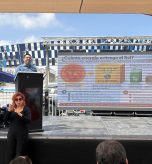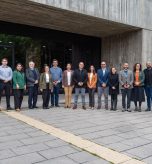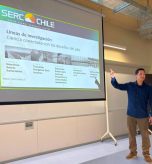


Within the framework of the seminar “The public challenge of environmental transformations in Chile,” an activity held during the university's sustainability week, the launch of “Las energías de Chile,” a new edition of the distinguished Anales journal, took place. This event featured the participation of former President Ricardo Lagos, who was in charge of presenting the book, and an eminent discussion panel including Rodrigo Palma, director of SERC Chile.
On May 28, the Price Waterhouse hall of the Faculty of Economics and Business at the University of Chile opened its doors to the public for the launch of the Anales Journal “Las Energías de Chile”, a new edition of this distinguished scientific publication founded in 1844, the oldest in Latin America.
The activity brought together students, professors, and scientists, as well as the university's highest authority, Rector Víctor Pérez Vera.
The presentation of this book was led by former President Ricardo Lagos, a member of the Anales journal committee, who emphasized the relevance of this publication in the current national context. Subsequently, the new edition of the journal was commented on by a panel composed of Pedro Maldonado, Deputy Director of the Energy Studies and Research Program, Eduardo Esperguel, an electrical engineer from the same institution, and Rodrigo Palma, director of SERC Chile.
“It is impossible not to refer to the current moment the country is experiencing and what has recently been disclosed regarding the energy agenda—a challenge of progress for all from the government—where upon reading the Anales, a set of topics is found that provide an answer to the agenda,” commented Lagos.
The former President referred to the structure of this issue, which consists of four parts, the first three of which are of great relevance.
“This Anales issue begins with a policy review, followed by a perspective on what science says, and then addresses what the public proposes and their empowerment. It is around these three parts where I believe the contribution made is remarkable due to its characteristics, clarity, and relevance,” said the journal committee member.
The relevance of this publication, regarding the 7-point energy agenda proposed by the government, was one of the most prominent points in the expert panel dialogue held after Ricardo Lagos's presentation.
Among the reflections of that conversation moderated by Patricio López, a journalist from Radio Universidad de Chile, Rodrigo Palma maintained that the energy agenda proposed by the Government, while valuable in its content, lacks a long-term vision and goals.
When asked whether the energy agenda's efforts are aimed at providing more space for renewable energies, Palma replied:
“It shouldn't be said that there hasn't been progress. In fact, the change in law is proof of that. The agenda presented by Minister Pacheco is a starting point, but it lacks the ‘journey to the moon.’ Dreaming of a Chile that, within 20 years, can integrate its energy matrix with a significant contribution from solar and geothermal energy, among others, and even export this energy to the region.
Palma highlighted the contribution that universities can make in raising and developing these issues.
“If a path for development is identified, someone will have to take the baton. These elements must be raised, and universities have a role to play in that,” he commented.