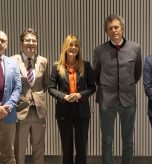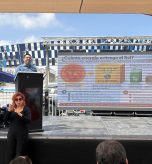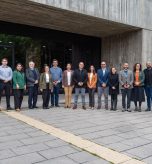


Launch ceremony held at the National Congress Hall of Honor
The Universities of Chile, Tarapacá, Antofagasta, Federico Santa María Technical University, Adolfo Ibáñez, and Concepción, together with Fundación Chile, inaugurated the first solar energy research center of excellence in Chile (Solar Energy Research Center, SERC Chile) on July 5th, created through the Conicyt Fondap program.
The launch ceremony was held at the National Congress Hall of Honor in Santiago, with the participation of the President of the Senate Committee on Challenges of the Future, Senator Guido Girardi; the Minister of Energy, Jorge Bunster; the President of Conicyt, José Miguel Aguilera; and the Director of SERC Chile, Professor Rodrigo Palma.
The event was attended by the rectors and senior authorities of the universities and the foundation that comprise this Center, which aims to become a leader in scientific research on solar energy, with special emphasis on developing the potential of the Atacama Desert. Likewise, more than 200 special guests were received, including government and Congressional authorities, members of the academic and scientific communities, and representatives from organizations and companies linked to the development of solar energy in Chile.
The project was born from the recognition of the unbeatable radiation and clarity conditions in the Norte Grande, which make it an optimal natural laboratory. However, both in the region and worldwide, barriers still persist that prevent the full development of this potential and are amenable to being addressed by science. SERC Chile aims to take advantage of these exceptional conditions to attempt to provide answers to key scientific questions aimed at overcoming those barriers.
The initiative is led by Professor Palma, along with five researchers of recognized trajectory, and more than 40 national and foreign researchers, who work with a multidisciplinary approach on the following six themes: “Solar energy in industry/mining”; “High-power electrical systems with solar energy penetration”; “Solar energy coordination systems for rural and urban communities”; “Solar energy storage”; “Solar water treatment”; and “Economic, social, and regulatory aspects for solar energy development,” which were defined in detail during the presentation.
Rodrigo Palma, director of SERC Chile, commented on the motivational importance of this ceremony for the team behind the project. “We had a great turnout, with the presence of decision-makers who can drive this dream forward with us. Our perspective is academic and we do not yet know the results, but everything indicates that the development of solar energy is a major opportunity that we must seize as a country,” he explained.
The center has an Advisory Board composed of: Dr. Andrés Weintraub Pohorille, National Prize for Applied Sciences 2000 and member of the Industrial Engineering Department of the University of Chile; Dr. Alejandro Jadresic, Dean of the Faculty of Engineering and Sciences at UAI and former president of the National Energy Commission; Dr. Alejandro Jofré, director of the Center for Mathematical Modeling at the University of Chile; Dra. Nicola Borregaard, Manager of Energy and Climate Change at Fundación Chile; and María Elena Boisier, director of the Fondap and Fondecyt programs at Conicyt. Likewise, it has an international collaboration network comprising the most prestigious solar energy research centers.
Also, in its application, the project was sponsored by the Ministry of Energy and the companies Enel Green Power, Minera Doña Inés de Collahuasi, Abengoa Chile S.A., and Minera Gaby SPA, currently Codelco's Gabriela Mistral Division.
Regarding the group of different organizations that form this solar energy center, Professor Palma explained that SERC Chile will fulfill an articulating role, linking decisions with companies and the real world. “In this field, we want to generate evidence and vision for investments and innovation in solar energy,” he stated.
Senator Guido Girardi referred to the launch of this center, asserting that scientific development is the most important challenge of any society and that the energy model determines civilizations. “Chile needs to create more of a vision for the future since it has immense potential to lead the world in solar energy development. Due to its irradiation rates, the Atacama Desert could even provide energy to all of Latin America. Chile can become the main solar research hub, and it depends on science, joined with academia, business, society, and citizens, to make that possible,” he concluded.
SERC Chile seeks to generate new scientific research that provides a solid knowledge base regarding solar energy; contribute to the training of human capital that assists with the understanding, application, and dissemination of solar energy; and educate, inform, and interact with citizens and public policymakers about the importance and potential of Chile's solar resources, making our country a global benchmark for solar energy and development.
International conference
Following the ceremony, the International Conference “Solar Energy Challenges in Chile and the World” was held in the same Hall of Honor, where the following international guests spoke about different ways to implement solar energy and the immense potential offered by Chile with the Atacama Desert for its effective and sustainable development.
Julián Blanco, Ciemat-Almería, head of the Environmental Applications of Solar Energy area. Expert in solar desalination processes and technologies for seawater and brackish water. Coordinator of the Joint Program on Concentrated Solar Power of the European Energy Research Alliance (EERA).
Peter Strittmatter, University of Arizona, Director of the Astronomy Department at the University of Arizona, United States, and the Steward Observatory. Specialist in advanced optics development, currently initiating a project applying astronomical technology in the field of solar energy.
Radovan Kopecek, Managing Director of Advanced Cell Concepts, member of the Executive Committee, ISC Konstanz, Germany. He is one of the founders of that research center, where he has been manager and researcher since 2007. Currently directs several projects in Germany and Europe regarding the development of photovoltaic cells.
The program concluded with a panel moderated by Professor Rodrigo Palma in which, along with these speakers, Professor Emeritus of the Pontificia Universidad Católica de Chile Hugh Rudnick, and solar energy expert Professor Roberto Román, engaged in a dialogue with the attendees.