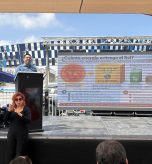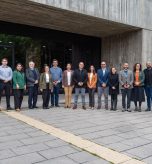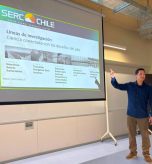


The launch of the “Las Energías de Chile” issue took place during the seminar “The Public Challenge of Environmental Transformations in Chile,” an event held as part of the university’s sustainability week, representing a new edition of the magazine Anales de la Universidad de Chile. The book was presented by former President Ricardo Lagos and featured a prominent discussion panel, which included Rodrigo Palma, Director of SERC Chile.
On May 28, the Price Waterhouse auditorium at the University of Chile’s Faculty of Economics and Business hosted the launch of the “Las Energías de Chile” issue of Anales magazine. This distinguished scientific publication, founded in 1844, is the oldest in Latin America.
The event brought together students, faculty, and scientists, alongside the university’s highest authority, Rector Víctor Pérez Vera.
The book was presented by former President Ricardo Lagos, a member of the Anales editorial committee, who underscored the importance of the publication in the current national context. This was followed by a discussion on the new edition featuring a panel composed of Pedro Maldonado, Deputy Director of the Energy Research and Study Program; Eduardo Esperguel, an electrical engineer from the same university; and Rodrigo Palma, Director of SERC Chile.
“It would be impossible not to reference the country’s current landscape and the realities revealed by the energy agenda. It represents a development challenge for all government stakeholders; upon reading Anales, it becomes clear that the publication provides answers to several key issues on the agenda,” Lagos remarked.
The former President referenced the structure of this issue, which is divided into four sections, highlighting the primary significance of the first three.
“This edition of Anales begins with a political review, followed by scientific perspectives on the subject, and concludes with the demands and empowerment of the citizenry. These three sections offer the most significant contribution due to their clarity and relevance,” the committee member told the magazine.
The significance of this issue’s publication was emphasized by the expert panel following Ricardo Lagos’s presentation, particularly in relation to the seven strategic axes introduced by the government.
During the discussion moderated by Patricio López, a journalist from Radio Universidad de Chile, Rodrigo Palma noted that while the government's energy agenda is valuable in content, it lacks long-term vision and objectives.
When asked about the energy agenda and whether efforts are aimed at expanding the role of renewable energies, Palma stated:
“It would be incorrect to say that there have not been developments in this area; legislative changes are proof of that. The agenda presented by Minister Pacheco is a starting point, but it lacks ‘moonshot ambition’—the vision that in 20 years, Chile will be able to integrate geothermal and solar energy into its grid and perhaps even export energy to the region.”
Palma emphasized the contribution that universities can make toward raising awareness and advancing these issues.
“Once a development path is identified and validated, leadership is required. The necessary frameworks must be established, and universities must lead that work,” he noted.