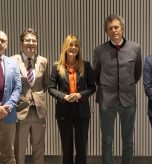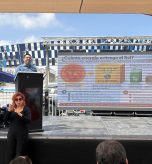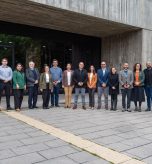

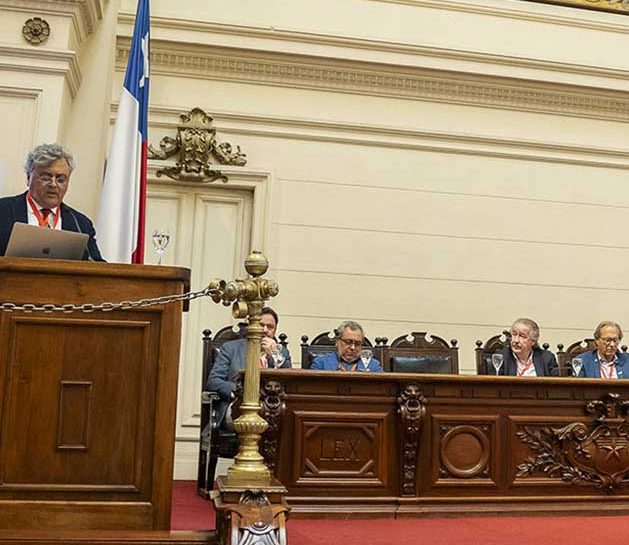

The event brought together authorities, academics, students, and the community to celebrate achievements and outline the strategic challenges of the energy sector within a context of global transformation in solar matters.
SERC Chile (Solar Energy Research Center), the FONDAP Center of Excellence, closes its first 13-year cycle driving the country's scientific and technological development in solar energy. With the presence of the Minister of the Environment, a ceremony was held on Wednesday, December 3, at the Hall of Honor of the Former National Congress in Santiago, highlighting the “Achievements and Challenges to make Chile a solar nation”.
The activity was attended by authorities and academics who addressed the main milestones of these 13 years of collaborative work among six of the country's universities and the Fraunhofer Institute, representing a joint effort that has brought together more than 116 researchers and more than 2,300 students committed to the energy transition.

The Director of SERC Chile, Rodrigo Palma Behnke, who was in charge of presenting the achievements of the solar energy center, noted that this is the closing of a first cycle that contextualized a transformative spirit of the vision of the energy matrix in Chile, where solar energy has taken on an increasingly prominent role over these 13 years.
"This instance is primarily to express gratitude for the trust of the partner institutions of SERC Chile, who have chosen to accompany an ecosystem of researchers who share the dream of making Chile a solar nation by 2050, contributing scientific knowledge for a just, sustainable, and inclusive energy transition," Palma specified.

He also stated that, "It is important to highlight the people who make it possible for these projects to materialize and achieve impact in the community. It has been a long road, where we have managed to position a topic that a decade ago was not concretely thought of as part of a national development path, and we are very proud of that."

The event was attended by the Minister of the Environment, Maisa Rojas Corradi, who highlighted the scientific work of SERC Chile and underscored the importance of acting against global warming. "We must continue developing, especially in renewable energies, and even more so Chile, which shows it can become a benchmark on the continent and recognized worldwide; because of this, we are addressing an energy matrix that changes so rapidly and forces us to take charge, where scientific advice is more relevant than ever," Rojas stated.

For his part, SERC Chile's Principal Researcher, José Miguel Cardemil Iglesias, in his presentation on the challenges and continuity of Chile as an engine for innovation and energy transition through solar energy, highlighted that: "This journey has been quite long and has had different focuses, dedicated to building capacities, strengthening trust, and now to strengthening links between science, society, and industry. This means that, even though 2026 funding is uncertain, this platform we have built cannot stop. Our entire team is committed to Chile's solar future."
Along these same lines, representing the Rector of the University of Chile, the Dean of the FCFM, Francisco Martínez Concha, shared his reflections on the role of science, inter-institutional collaboration, and the construction of a solar vision for Chile: "We face climate change alongside technological change, and somehow we have found a way to address them together. This gives us hope, and this window directly challenges science, which compels us to seek and develop the necessary solutions to respond to the problems."
Among the participants in this key instance for reflecting on the role of academia and the strategic challenges of the energy sector, in a context of global transformation, were also the Deputy Director of the National Research and Development Agency (ANID), Nicole Ehrenfeld; Humberto Espejo, a member of the Board of Directors of the National Electrical Coordinator; and representatives from the University of Antofagasta, University of Chile, Pontificia Universidad Católica, Adolfo Ibáñez University, Federico Santa María Technical University, University of Concepción, and Fraunhofer Chile, which comprise SERC Chile.