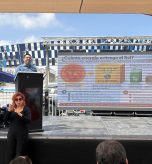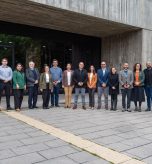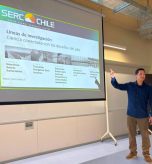


“Integration of Renewable Energies and Regional Interconnections in South America” was the title of the international workshop held on September 5 and 6 at ECLAC, organized by SERC Chile, the National Electrical Coordinator, and the Corfo Solar Committee, with sponsorship from the Ministry of Energy. The meeting was attended by experts from nine countries and international organizations, including Minister of Energy Susana Jiménez; Jeannette Sánchez, representative of ECLAC; Daniel Salazar of the National Electrical Coordinator; Patricio Espinoza of CONICYT; Professor Christian Rehtanz, representing the German scientific delegation; Rodrigo Mancilla of the Corfo Solar Committee; and Professor Hugh Rudnick, a member of the Strategic Research Committee of SERC Chile, who also served as moderator for the first session of the seminar.
In the inaugural panel, Minister Jiménez addressed progress in energy integration with neighboring countries and expressed Chile's commitment to advancing “interconnection within our South American region, thereby reversing the reality of being among the least interconnected in the world. The strengthening of our national power system will eventually allow us to open the door to the regional Andean market through the Andean Electrical Interconnection System (SINEA), which brings together the energy ministries of Colombia, Ecuador, Peru, and Chile, with Bolivia as an observer.”
During the two days of the workshop—which involved ministries, power system operators, researchers, and leading professionals from Argentina, Brazil, Paraguay, Colombia, Ecuador, Peru, Uruguay, and Chile—energy integration experiences in Europe were reviewed, specifically the German case, presented by speakers such as Albert Moser of RWTH Aachen, Christoph Weber of the University of Duisburg-Essen, Christian Rehtanz of the Technical University of Dortmund, and Ludger Eltrop of the University of Stuttgart.
The workshop fostered a dialogue on the importance of flexibility and resilience in future energy systems and discussed how technologies such as storage, demand-side management (DSM), and hydropower can contribute to these objectives.
All workshop materials are available here: