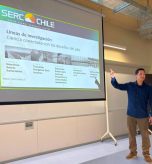


The northern zone of Chile has been described as one of the most arid in the world and is abundant in solar resources. The challenge for the future is to optimize this wealth to contribute to increasingly environmentally sustainable production. The International Cross-Border Course sought to contribute by disseminating knowledge related to the application of small and medium-scale solar solutions for water treatment as a sustainable development model in arid and semi-arid regions within cross-border zones, through studies, research, and project implementation experiences, aimed at training and advancing students, researchers, and professionals through eight international experts in the field.
Lorena Cornejo, leader of the Solar Water Treatment area of SERC Chile and coordinator of this international course, sees it as an opportunity to “promote the development of new technologies from the region that allow for the integration of renewable energies (…) that is why the knowledge network of renewable energy technology must be strengthened and expanded at the local level, proposing sustainable alternatives with technical, social, environmental, and economic feasibility that promote the sustainable development of our region and its decentralization.”
One of the experts who presented his experience in this course was Dr. Carlos Polo, Academic at the Universidad Jorge Basadre Grohmann, Tacna-Peru and expert in Photovoltaic Solar Energy. Polo stated that “in this area (southern Peru and northern Chile) we have great solar potential, and with all the experience we have, this should be replicated and improved; thus, the joint projection will be very positive for the development of this area, which faces a significant water deficit, where solar energy can be combined with water treatment and seawater desalination to increase the water supply.”
Another speaker with extensive experience was Engineer Jorge Quintanilla, Academic at the Universidad Mayor de San Andrés in Bolivia and an expert in Water Treatment, who indicated that this knowledge update is highly beneficial for the three countries that have been working together for some time in the cross-border network. In his view, the future of Solar Water Treatment depends largely on the commitment made by the three countries to develop the technology necessary to implement it and overcome the water deficit.”
This course was held in the city of Arica and was an activity funded through the SERC Chile Internationalization Funds Contest, 2019, and supported by the UTA/1799 Performance Agreement.