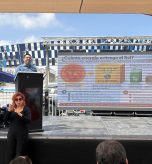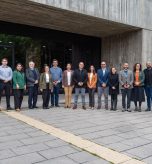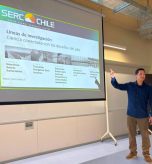


“Resilient planning of low-carbon power systems” is the project on which Rodrigo Moreno, a researcher at SERC Chile and academic at the University of Chile’s Department of Electrical Engineering, is working, alongside Fernando Ordóñez, a scholar at the FCFM-UCH, and Pierluigi Mancarella of the University of Manchester. It is also the project that won the latest edition of the Newton Prize from the British Government, which is awarded annually to recognize excellence in research or innovation.
The award-winning researchers developed a mathematical model to create a framework that will increase the resilience of energy systems in Chile and other countries vulnerable to environmental hazards. This will assist in establishing planning practices and developing a resilient, low-carbon transmission network.
“Currently, our standards compare unfavorably with those of other OECD (Organisation for Economic Co-operation and Development) member countries. For this reason, the objective of this project is to raise those levels, ensuring that people experience fewer hours of power supply interruptions in their homes each year,” stated Rodrigo Moreno.
The research aims to provide households with response strategies that are complemented by community-based resilience measures. In the words of Rodrigo Moreno, “the ultimate goal is for this project to help people.”
This year, the Newton Prize sought to highlight collaboration between the United Kingdom and Latin America. A total of 140 projects were submitted by researchers from Chile, Brazil, Colombia, and Mexico, in partnership with British researchers.