

By Douglas Olivares, PhD in Solar Energy and SERC Chile researcher – UA

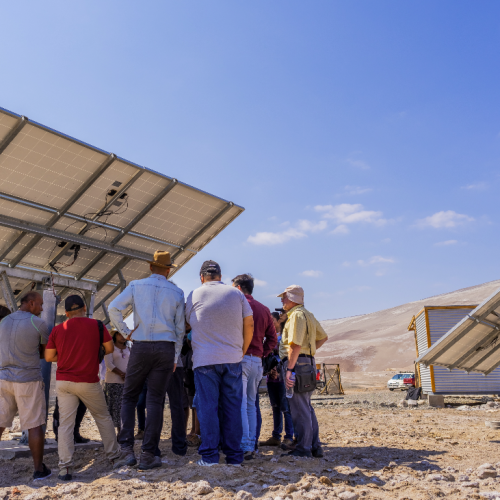
The Atacama Desert holds one of the greatest solar resources on the planet. However, even the most promising scenarios face challenges. In this case, the antagonist is called soiling: the accumulation of dust (organic and inorganic) that reduces the efficiency of solar panels by accelerating material wear and compromising durability. Its effects impact not only electricity generation but also the sensors and equipment within this ecosystem.
This goes beyond the extreme aridity of this region of the country. Mining, the economic pillar of the north, releases pollutants that intensify particle deposition and promote cementation processes that are difficult to reverse. Simultaneously, microorganisms resistant to the extreme climate colonize surfaces and generate biofilms on photovoltaic glass, reducing its transparency and accelerating its deterioration. In this way, soiling emerges as a hybrid phenomenon, where natural and human processes converge, demanding scientific and technological responses commensurate with the territory.
The consequences are quantifiable. In some projects, the loss of efficiency exceeds 20%, a critical decline for systems that depend on long-term efficiency. On a global scale, this phenomenon represents losses of billions of dollars annually. For a country that positions solar energy as a strategic pillar, the challenge is clear: to transform an obstacle into a platform for innovation and to reinforce energy leadership.
Solutions are already underway. In Chile, various research centers, such as the Solar Energy Research Center (SERC Chile) and the University of Antofagasta, are investigating how soiling, among other phenomena, affects solar technologies. Simultaneously, the Energy Development Center of the University of Antofagasta promotes applied studies and proposes mitigation strategies. These efforts demonstrate that this is not merely a technical issue, but an opportunity for science and innovation to support the local energy transition with global impact.
Meanwhile, the Atacama Desert will continue to be the hero of this story, harboring some of the greatest solar wealth on the planet. Soiling—like other phenomena inherent to this extreme environment—reminds us that every opportunity carries a challenge. Chile's energy future will depend on our ability to transform this antagonist into a driver of innovation and long-term vision.