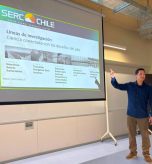


60 researchers from various universities across the country were present to address the scientific foundations of solar energy development and the current potential to contribute to carbon neutrality goals.

SERC Chile (Solar Energy Research Center) held its annual meeting this July to present the progress, projects, and challenges of the country's energy transition, while also working on the continuity guidelines for the research center, which is currently in its 12th year of operation.
This year's plenary session was held in the Metropolitan Region and brought together 60 of the 80 SERC Chile researchers, who belong to various universities throughout the country, where they shared and debated the scientific foundations of solar energy they are currently working on to contribute to the goal of being a carbon-neutral and climate-resilient country by 2050 at the latest.
The director of SERC Chile, Rodrigo Palma, stated that the goal of these types of events is to co-construct a solid knowledge base regarding solar energy to harness the exceptional conditions of the northern part of the country. “Through research, we promote actions that enable the establishment of the northern zone of the country as a scientific hub in global solar energy research. These annual plenary sessions of SERC Chile serve to address strategic issues such as these, as well as the continuity guidelines and foundations of our center,” Palma said.
He also noted that they remain steadfast in addressing the multidisciplinary study of barriers yet to be resolved by science, from the perspective of six research lines: solar energy in industry/mining; high-power electrical systems with solar energy penetration; solar energy coordination systems for rural and urban communities; solar energy storage; solar water treatment; and economic, social, and regulatory aspects for solar energy development.
Currently, SERC Chile brings together more than 80 researchers and is composed of the Universidad de Antofagasta, Universidad de Chile, Pontificia Universidad Católica, Universidad Adolfo Ibáñez, Universidad Técnica Federico Santa María, Universidad de Concepción, and Fraunhofer Chile.

Recognition and awards
During the event, SERC Chile gave special recognition to three researchers who, as of this year, are no longer active members of the center, acknowledging each of them for their involvement since the origin of the Solar Energy Research Center: Dr. Hector Mansilla, professor emeritus at the Universidad de Concepción; Dr. Héctor Galleguillos from the Universidad de Antofagasta, for his research in energy storage; and a post-mortem recognition to the energy expert and professor emeritus of the Universidad Católica, Hugh Rudnick.