

- SERC Chile led an important international seminar where technical, political, and economic challenges were debated and analyzed to advance the path toward the region's energy transition.
- The Minister of Energy, Diego Pardow, explained the stages of interconnection Chile is currently undergoing with Peru and Bolivia. “Together with the Inter-American Development Bank, in the case of Peru, we are updating the costs of the project that makes the most sense from the first step of interconnection, and in the case of Bolivia, we are still narrowing down the initiative at a pre-feasibility stage.”
How is progress being made on energy interconnection in Latin America? In the “International Seminar on Energy Interconnection in Latin America: Technical, Political, and Economic Challenges,” held by the Solar Energy Research Center (SERC Chile), sector representatives gathered with the aim of reducing variability and uncertainty to begin providing bilateral security and stability.
The meeting was held in the auditorium of the University of Concepción in Santiago, Chile, a setting that allowed for the creation of key alliances in academia, industry, and the public sector to optimize the use of abundant renewable energy resources, reinforce resilience to supply and demand fluctuations, and enable the export of green hydrogen and derivatives.

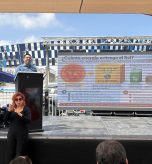
Photo: Minister of Energy Diego Pardow participated in the seminar
The welcoming remarks at the meeting were delivered by the Minister of Energy, Diego Pardow, who emphasized the need to create an interconnection between Latin American countries to advance the energy transition: “For Chile, energy interconnection has always been a priority. (...) As a cabinet, we had to take up previous work and reinforce that previous work, actively participating in the CESUR and CINEA initiatives, which are the regional and sub-regional organizations that allow this discussion to be organized.”
In this regard, following the meeting, the Minister explained the stages of interconnection Chile is currently undergoing with Peru and Bolivia. “Together with the Inter-American Development Bank, in the case of Peru, we are updating the costs of the project that makes the most sense from the first step of interconnection, and in the case of Bolivia, we are still narrowing down the initiative at a pre-feasibility stage.”
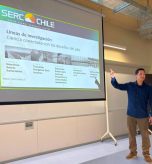
For his part, the director of SERC Chile, Rodrigo Palma, indicated that the seminar sought to “generate evidence and update this discussion with the results that SERC Chile has generated on the subject and bring this evidence to decision-makers, so that more information is available.”
Technical, political, and economic challenges of interconnection
Dr. Claudia Rahmann Zúñiga, Director of the Department of Electrical Engineering at the Faculty of Physical and Mathematical Sciences of the University of Chile, and former director of SERC Chile, who was a speaker, explained the potential for solar energy development during her talk “Technical challenges of a regional interconnection in Latin America.”

Photo: SERC Chile – UCH researcher (former director), Dr. Claudia Rahmann, was a speaker.
“At a regional level, by the end of 2023, we had 49 gigawatts installed, mainly photovoltaic, but the potential we have in South America is 33,000 gigawatts. This means that we have seen a massive development of renewable energies, but we must use all the potential we have to evolve that renewable energy strategy at a regional level,” Rahmann Zúñiga detailed.
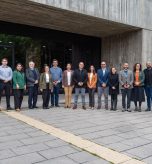
The event was attended by Diego Pardow, Minister of Energy; Iván Morán, SEREMI of Energy; Dr. Marcela Angulo González, Director of the University of Concepción-Santiago Unit; Dr. Marcelo Pérez Leiva, Associate Professor at the Universidad Técnica Federico Santa María and SERC Chile Researcher; Andrés Rebolledo Smitmans, Master’s degree, Executive Secretary of the Latin American Energy Organization (OLADE); Dr. Gerardo Blanco Bogado, Associate Professor at the Pontificia Universidad Católica de Valparaíso; Javier Moreno Jorquera, Master’s degree, economist at the Central Bank of Chile; and Dr. Claudio Agostini González, Associate Professor at the Universidad Adolfo Ibáñez and Principal Investigator at SERC Chile.